
An interview with artist and curator Siobhan McLaughlin on her 2026 residency at the Hugo Burge Foundation.
As 2026 draws to a close, we caught up with recent resident Siobhan McLaughlin to reflect on her time in the studio and explore how stepping away from the everyday can reshape and expand a creative practice.
Could you tell us a little bit about yourself and your practice?
I’m an artist and freelance curator working between Glasgow and Penzance. Working with remnant textiles and gathered earth pigments, my practice connects experiences of the landscape layered with memories and connections to people, the body, and time. Exploring themes of place, care and sustainability through painting and printmaking, I consider how past and current activities leave impressions on our ecologies. Recent exhibitions include Extraction at Jupiter Artland, Edinburgh (2026); Ten Good Years at the Heong Gallery, Cambridge (May 2026); The Five Sisters, A_Place Gallery, Glasgow (solo, 2025) and Pilgrimages, Hweg, Penzance (solo, 2024). I’m delighted to have recently received a Doctoral Landscape Award to undertake a practice-based PhD at the University of Dundee, working with communities to investigate creativity as a method of repair and hopeful potentials for derelict land.
What were your expectations before coming to the Hugo Burge Foundation? What were you hoping to work on while on residency?
I was looking forward to spending time deeply looking at and understanding Blackadder’s Self Portrait with a Cat, a painting with such rich colour and interesting composition. I keep postcards and photographs of several artists work in my studio at home, but none are self-portraits so I was interested to look at this format, to reflect on my abstract-landscape practice, thinking about how or why landscape reflects the self. I also planned to delve into Blackadder’s use of colour, finding equivalents in local earth pigments that I might discover while walking around Marchmont and Duns. I wanted to consider how Blackadder’s 1990’s oil painting could be translated into a contemporary, ecologically engaged series of work. Also, importantly, I was excited to meet the diverse creative community at the foundation and hoped to walk with other artists and makers.
Your residency was in partnership with the Royal Scottish Academy as part of their 200th-anniversary celebrations, giving you the unique chance to live, work, and respond to Dame Elizabeth Blackadder’s Self Portrait with a Cat (1976) from their collection. How did your relationship with the painting evolve over that time, and how did it ultimately influence your own work?
It really was a privilege to be gifted the time for sustained looking, to properly and closely look at the painting and try to work out how it was made. Initially I was interested in the deep ochre/raw sienna colour in Blackadder’s self-portrait, and gathered small amounts of earth while on walks with other makers at the foundation. On one evening walk, chosen by one of the Springboard Studios artists-in-residence, I saw the meeting of two fields, one a deep red and the other an acidic yellow. There’s something intimate and special about walking with others in their favourite local landscapes, and I started to build up a bit of a portrait of the place. On days I was less mobile, I became interested in the relation between objects in the painting: the intensely coloured image held within a bordered mirror, placed slightly off-centre; the delicately detailed panel shutters contrasting with the abstract blocks of the bedhead or is it a fireplace; the cat intently gazing out is the same height as the simplified candlestick. Blackadder’s head is the exact same height as my palm.
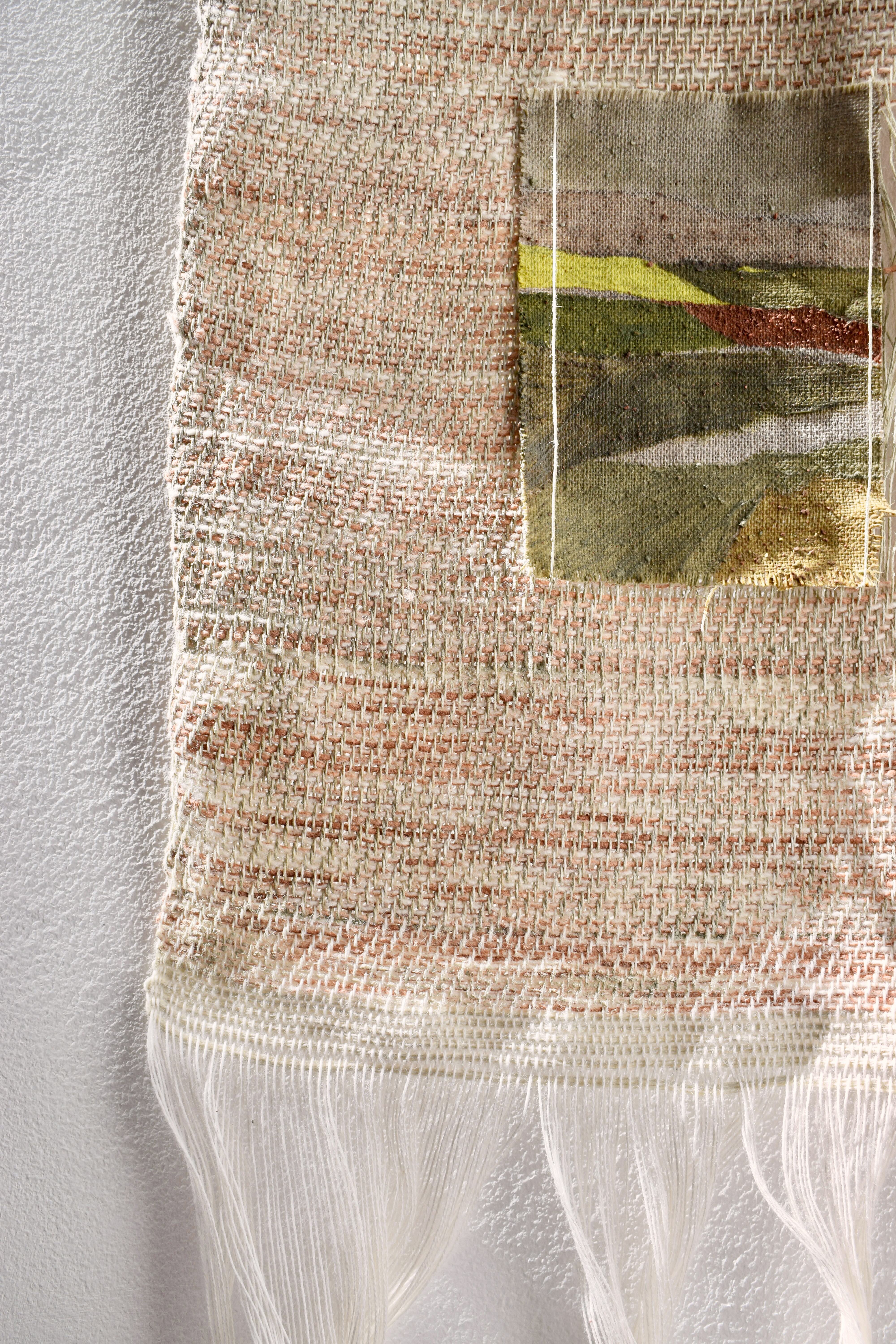
I then started to make small paintings, the height and width of my palm, of memories of landscape. These were placed within other artworks, or on larger paintings a palm sized composition was placed where Blackadder’s head would be.
How did encounters with other artists, the local community or the surrounding landscape shape your experience?
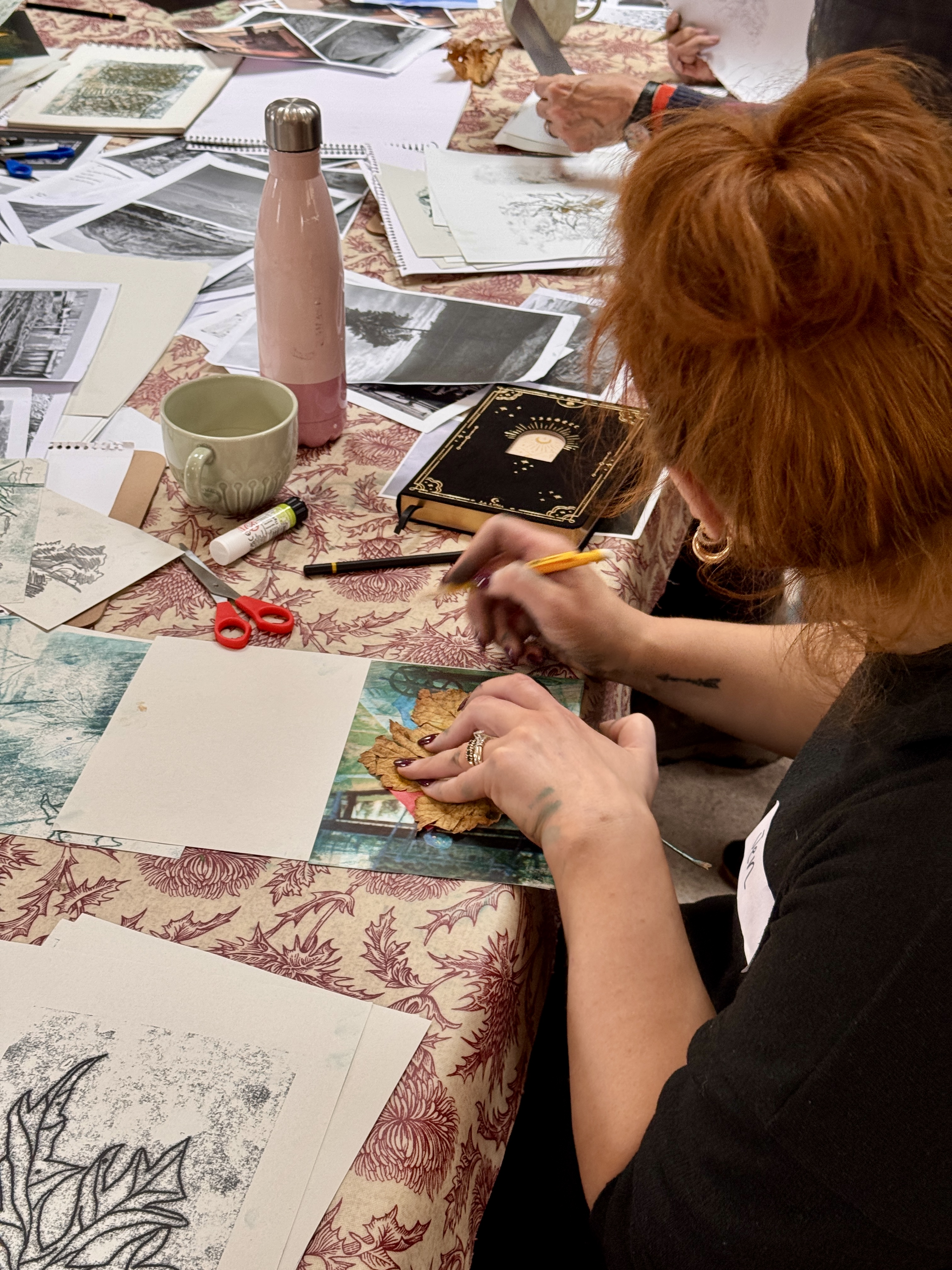
The other artists on site had such a great impact on me. I loved sharing my practice in studio sessions, showing how I grind pigments as well as collaborating with other makers, leading to experimiments with ground earth in a kiln to change its colour.
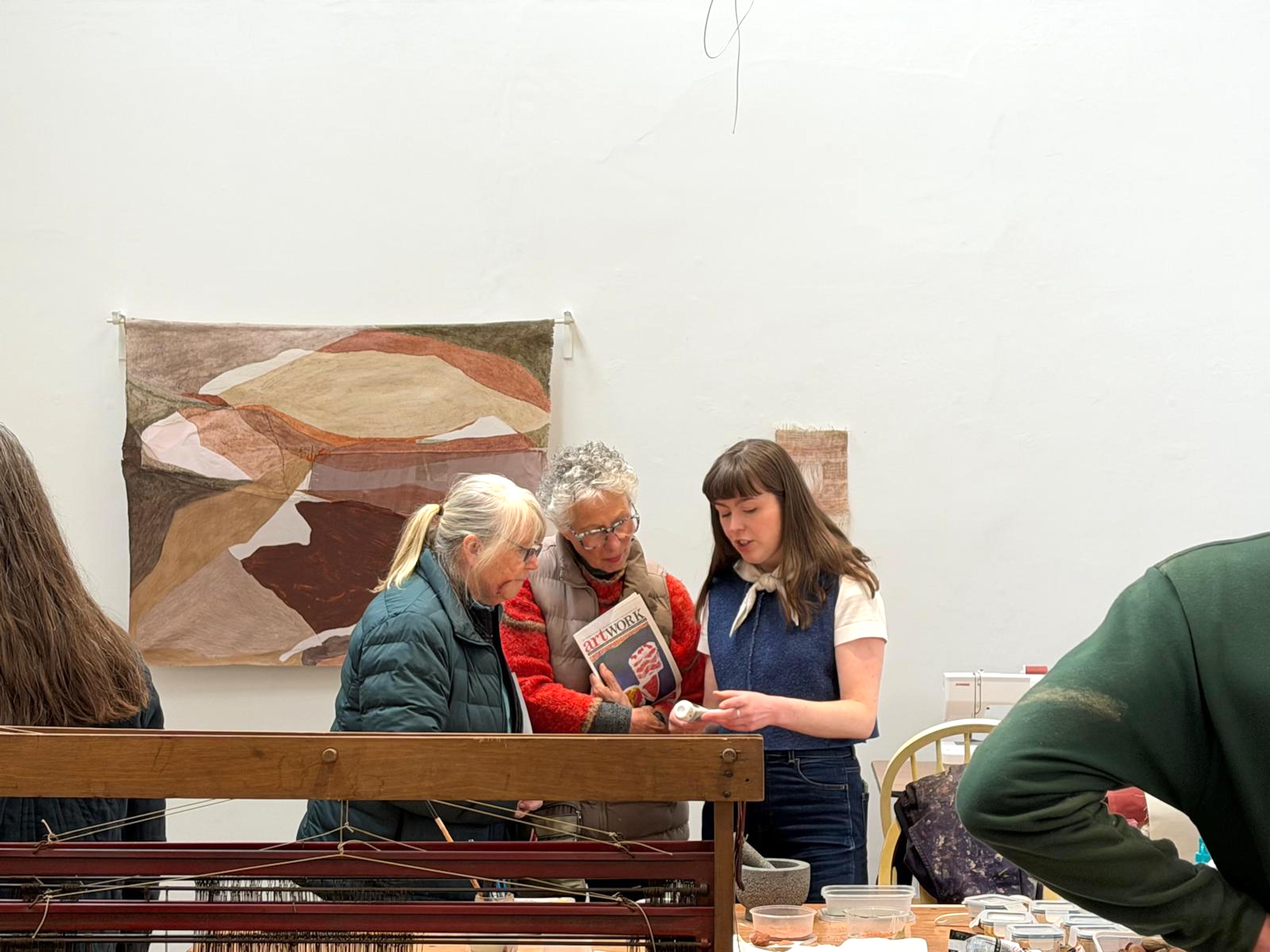
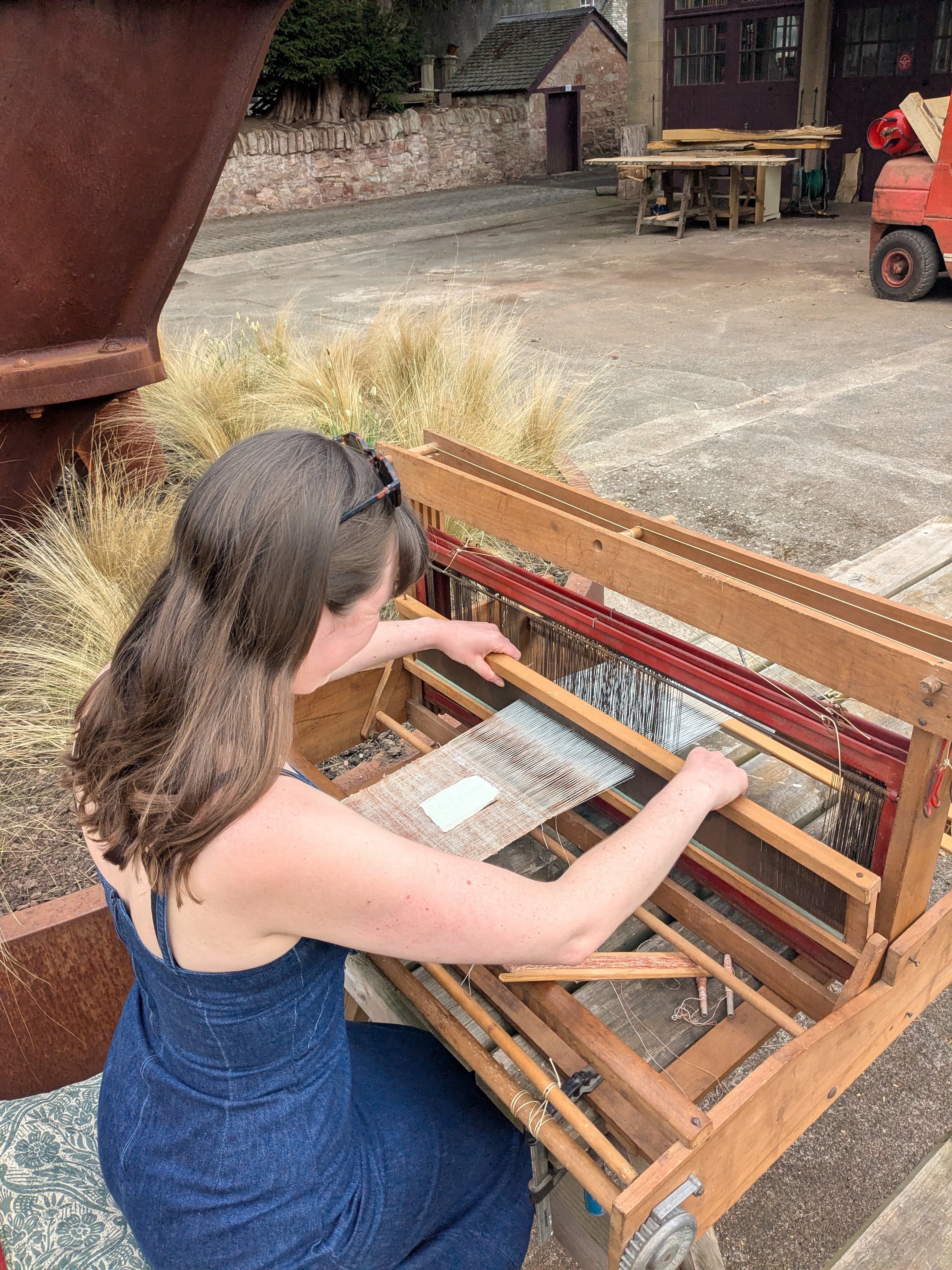
Scarlett Farrer, a textile artist and weaver, in particular was a generous and excellent teacher. It was incredible to learn with Scarlett, to create new works that combine earth and cotton. I experimented with coating yarn with earth pigment from a nearby field, and weaving strips of discarded paintings to be held within the structure, or creating a gap for a palm sized painting to be held. I found the repetitive structure and pattern of weaving, outside on a picnic bench, gave me a different feeling of headspace to painting, and it was invigorating to learn a new skill that I’ll continue to develop in my practice.
What did you take away from the residency? Was it different from what you expected? Has it had any effect on your practice since you’ve left?
It was a month of collaboration, walking, stillness, skill sharing, earth gathering, meal making, and looking so closely at Blackadder’s painting. The rest, conversation and slowing down in this residency confirmed the real need I had for space and time outwith the home studio and everyday appointments. It gave me time to experiment with new processes and to actually test, experiment and explore. I plan to continue developing a weaving practice, to incorporate it into my large scale paintings. And lastly it’s the connections I made that resonate, the collaboration and conversations with ceramacists, weavers and furniture makers that I hope to take into my practice in the future.
Many thanks to Siobhan McLaughlin for taking the time to speak about her residency experience. You can learn more her work at siobhanmclaughlin.co.uk.